

Cheshire East wants to cut working-age council tax support from April 2027, and 306 households would lose it. What changes, who is spared, and how to respond.
Updated 23 October: the consultation is now open and closes on Sunday 10 January 2027. The council announced it on 20 October and says no decision has been made; a final report will go to Cabinet and Full Council before the 2027/28 scheme is set. You can read the proposals and respond on the council’s survey site, linked from its consultations page. (council release)
Updated 20 October: Cabinet agreed unanimously on 8 October to review the scheme and run the 12-week consultation. It has not opened yet: the minutes say legal advice and equality assessments will be completed first, and the proposals will go to scrutiny before any final decision. (Cabinet minutes)
Low-income households of working age in Cheshire East could get less help with their council tax from April 2027. On Thursday 8 October the council’s Cabinet will be asked to approve a 12-week public consultation on a cheaper scheme.
The alternative scheme would cut the average working-age award by £3.78 a week, according to the report. It prints the averages as £21.72 now and £17.31 under the new scheme, which are £4.41 apart; the report does not explain the gap. 306 households would lose their support altogether. Over a year, that average cut comes to about £197 per household. (Cabinet report C/92/26-27)
Nothing has been decided yet. The report says plainly that “no decision to implement the alternative scheme has been taken”. Any final scheme would go back to Cabinet and then to Full Council.
What would change
Today, working-age claimants can get up to 80% off their bill. The alternative scheme would:
- cut the maximum award from 80% to 70%
- cut every lower discount rate by 10 percentage points
- cap support at the Band B level, so people in bigger homes get no more help than someone in Band B
- tighten the income thresholds by 5%
Pensioners are not affected. The pension-age scheme is set nationally, and councils can only change the working-age one. The report also confirms that Cheshire East care leavers can still get 100% relief up to the age of 25.
Who would lose most
The modelling was done by the consultancy Policy in Practice, using the council’s own caseload from February 2026. That covered 17,571 claims: 10,807 working age and 6,764 pension age.
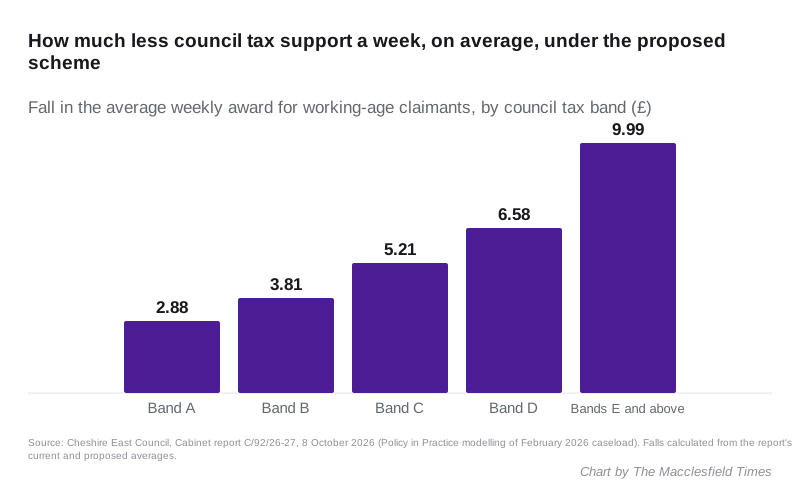
The cut grows with the size of the home, because of the Band B cap. Average weekly awards would fall like this:
| Council tax band | Average award now | Under the alternative | Weekly cut |
|---|---|---|---|
| A | £19.16 | £16.28 | £2.88 |
| B | £21.59 | £17.78 | £3.81 |
| C | £24.03 | £18.82 | £5.21 |
| D | £26.69 | £20.11 | £6.58 |
| E and above | £29.86 | £19.87 | £9.99 |
The 306 households modelled to lose all support are mostly in the cheapest homes:
- Band A: 103
- Band B: 95
- Band C: 52
- Band D: 25
- Bands E to H: 31
They are the households whose new award falls below the minimum payment, so it drops to nil. That is 2.8% of working-age claims.
How much the council would save
The current scheme is modelled to cost £22.150m in 2027/28. The alternative would cost £20.024m, about £2.126m or 9.6% less.
The report repeatedly warns that this is not a guaranteed saving. Some of it could be lost to unpaid bills, arrears, write-offs, hardship payments and extra demand on other council services. It lists legal challenge, financial hardship and lower collection among the main risks.
The report also says the modelling found “legal risk” in how the current scheme treats Universal Credit, including possible double-counting of income. Fresh legal advice is needed before any consultation is published.
Who will be asked
If Cabinet agrees, the consultation will run for 12 weeks. The council says it will seek views from:
- residents
- the police and fire authorities, which also take a share of council tax
- advice and welfare organisations, and the voluntary sector
- housing providers
- groups representing disabled people, carers and families
The report asks for worked household examples and an initial equality impact assessment to be published with it. Council officers in adult care, public health, children’s services and housing have been asked to assess the effect on the people they serve.
What it means for you
If you are of working age and get council tax support now, your bill from April 2027 could rise. On the modelled averages, a Band D claimant would pay about £6.58 a week more.
The consultation is open until Sunday 10 January 2027, and it is the one chance to tell the council how a cut would affect your household. Anyone can respond, whether or not they get council tax support now: take part on the council’s survey site.
The council also says anyone already struggling should contact it early rather than wait. Its benefits and welfare teams can check what you are entitled to, including the Crisis and Resilience Fund.
If you are struggling with your bill now, our Macclesfield council tax bands page sets out the discounts and the support you can already claim, and how to apply.
Cabinet approved the consultation at its meeting on 8 October at Delamere House, Crewe. (agenda)
Have your say